

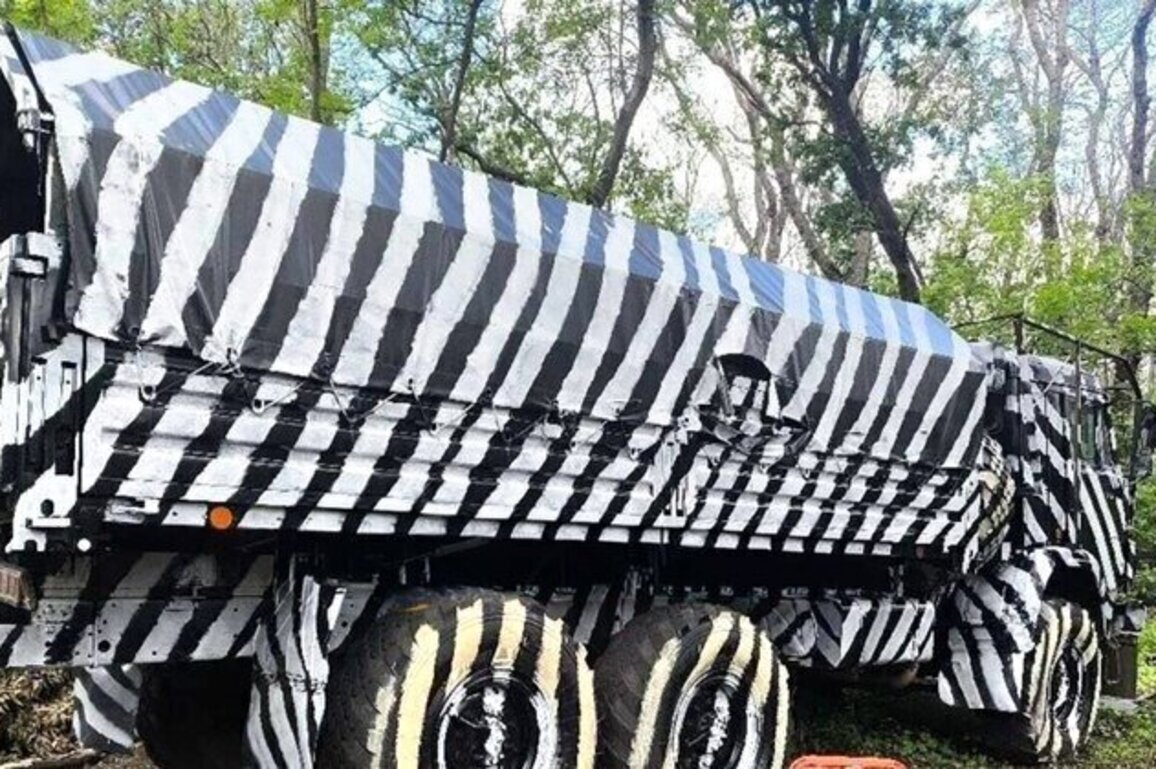
Russian military vehicles are being painted with vivid stripes to baffle AI systems of Ukrainian-launched drones, experts say. Now the "cloaking" tactic has apparently launched a high-stakes game of hide and seek on the highways of Russian-held territory in Ukraine.
Pictures of Russian military vehicles overpainted with "dazzle camouflage" emerged in recent days as Ukraine has ramped up a "middle strike" drone campaign to hit Russian logistics equipment up to 200 kilometers from the front lines.
Ukraine is launching kamikaze drones, including theUS-made Hornet, in its ongoing midrange drone attacks that have included destroying trucks on roads shared by civilian and military vehicles.
A Russian logistics vehicle painted in black and white stripes at an unspecified location
Geert De Cubber,a specialist in autonomous systems at the Military Academy of Belgium, says military AI systems are trained with pictures of obvious targets before being released into battle.
"You feed the algorithm a very large number of labeled images and the algorithm will learn for itself how to associate the features such as colors, patterns, textures, and gradients in the image to labels," he told RFE/RL.
In the context of Ukraine, visual cues such as forest green color schemes and the "Z" symbol associated with Russia's invasion of Ukraine would be obvious inputs to visual identification algorithms.
Zebra patterns appearing on trucks in recent days may be able to throw some optical hunting systems off the scent, De Cubber explains.
"If the dazzling patterns are not in the [drone's] database, then they would certainly have an effect on the performance of the detector," he says.
In military applications, the robotics expert says, AI targeting menus must remain tightly constrained.
"If you train the algorithm on military buses, you wouldn't want it to generalize the detection to school buses."
A Hornet kamikaze drone captured flying over a highway near Mariupol in Russian-held territory of Ukraine
Todd E. Humphreys, an aerospace and AI expert at the University of Texas at Austin, agrees the paint tactic may be more effective than many realize.
"Dazzle paint pushes the vehicles 'out of distribution' -- they no longer look, to the AI classifier, like the images it was trained on," he told RFE/RL.
But any specific paint job would have a brief shelf life, Humphreys adds.
"A human can easily detect the disguise, but the AI classifier would need to be retrained on thousands of images of vehicles with dazzle paint, after which the paint scheme could be changed and the cycle starts again."
A Russian truck painted with swirling patterns
That evolution in patterns may be under way already. Recent images show a Russian truck with a swirling black-and-white paint scheme distinct from the earlier zebra stripes seen on social media.
A spokesperson forBrave1, a Ukrainian initiative behind many of Ukraine's battlefield innovations, told RFE/RL that Russian forces are "continuously testing new camouflage, and we are continuously adapting too to ensure the effectiveness of the combat ops," adding he had "no comment on the specifics."
Some expertshave suggestedthe hornet drone being used by Ukraine is capable of identifying and striking targets completely autonomously.
Brave1's spokesman says drone strikes are "always authorized by a human," adding that "AI may help at certain parts of the process, but a human is always firmly in control."
A Hornet attack drone on its launch catapult during a demonstration in Germany in March
US-made Hornet attack drones have been in use by Ukraine since this spring and cost a reported $6,000 per unit. The polystyrene dronesreportedly offera "choose-and-forget attack sequence" in which an operator selects a specific object that may have been flagged by AI and the drone then swoops in to strike. Such capability could allow for a single human operator to oversee several drones simultaneously as they prowl for targets.
Russia's military has previously employed pattern-concealing efforts amid its war on Ukraine. Images of valuable Russian aircraft with tires placed on their wings that emerged in 2023 baffled observers at the time.
The following year Schuyler Moore, the chief technology officer of US Central Command at the time, raised the topic during a discussion on AI targeting as a "classic unclassified example" of concealment.
"You're looking for a plane and then if you put tires on top of the wings, all of a sudden, a lot of computer vision models have difficulty identifying that that's a plane," she said.
A Russian strategic bomber aircraft is seen covered in tires at the Engels-2 Air Base near Saratov in 2023.
For long-range missiles that might be programmed to autonomously identify and hone in on aircraft on a tarmac, such simple deception could trick even advanced weapons systems.
Russia has previouslypainted outlinesof submarines and aircraft on their bases in an effort to lure potential incoming missiles onto empty concrete.
Zebra Trucks: Why Russia Is Using 'Dazzle Camouflage' In Ukraine
ShareCopy link
Facebook
X (Twitter)
LinkedIn
Email
Share
ShareCopy link
Facebook
X (Twitter)
LinkedIn
Email
Share
Follow usFacebook
X (Twitter)
Youtube
Instagram
Follow us